

AI receptionist cost ranges from $25 to $899 a month as of mid-2026, and most small business owners pick the wrong tier because they’re comparing the wrong things. This guide breaks down every pricing model in the market, runs the Phoenix salary math, and tells you where the floor actually is for a product that moves the needle on missed calls.
Key Takeaways:
- AI receptionist plans range from $25/month (basic autoresponder tier) to $899/month (hybrid human-AI with live escalation). The sweet spot for most small businesses sits between $97 and $497/month.
- A Phoenix receptionist costs $30,000–$42,000 per year in salary alone, before benefits, PTO, and turnover. An AI answering service at $397/month runs roughly $4,764/year, a gap of $25,000–$37,000.
- Per-minute pricing looks cheap at $0.10–$0.35/minute but punishes high-call-volume businesses. Flat-rate plans become cheaper at roughly 300+ minutes of handled call time per month.
What Does an AI Receptionist Actually Cost in 2026? The Market Price Bands
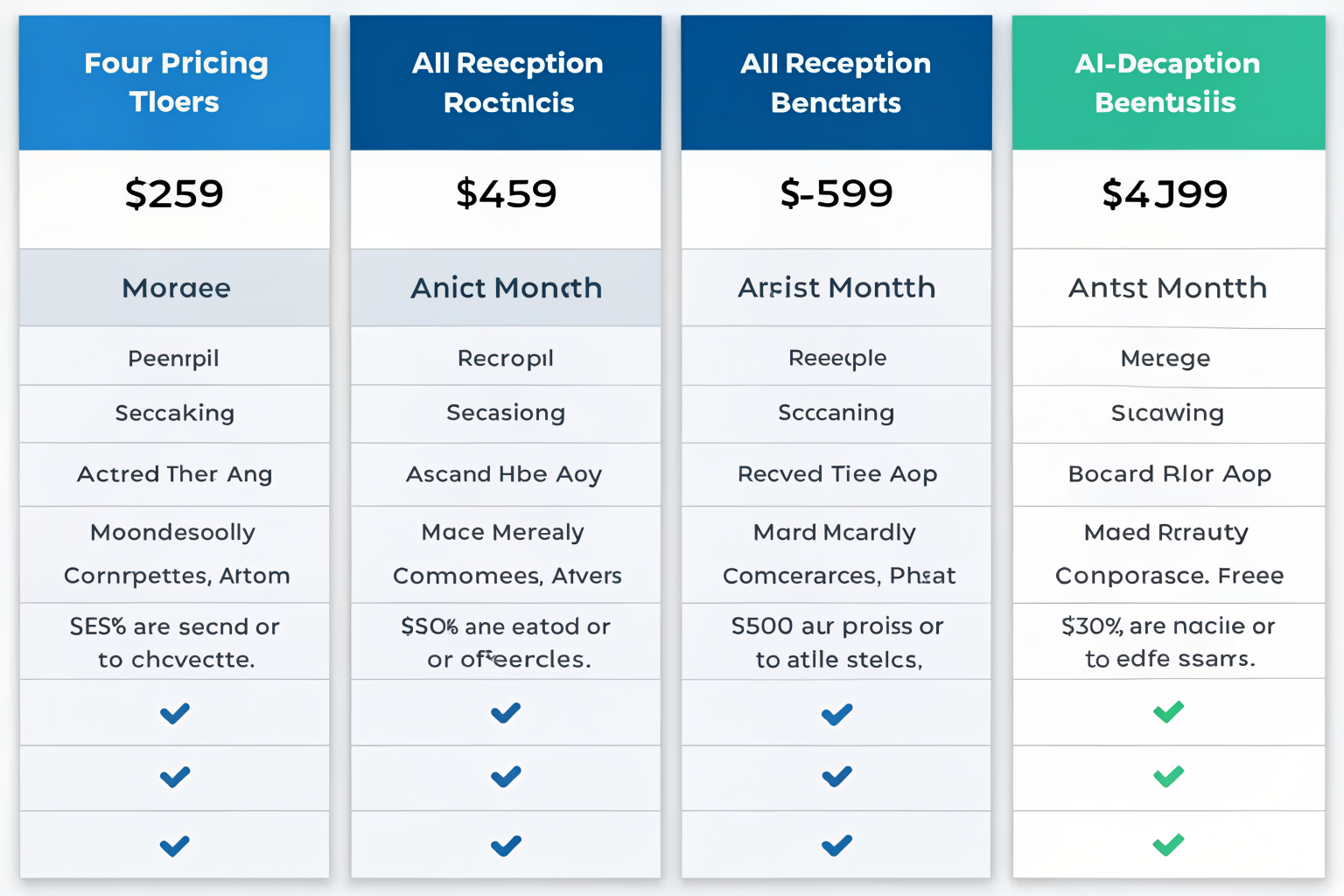
AI receptionist pricing spans four distinct market tiers from $25 to $899/month. That range sounds wide, but the differences between tiers aren’t cosmetic. They reflect fundamentally different products, different labor models, and different levels of call-handling capability. Understanding where each tier starts and stops is the first step in knowing what you’re actually buying.
This is where most buyers go wrong: they search for the lowest number, find a $29/month product, and assume they’ve found a deal. What they’ve found is a text-back autoresponder. It does not pick up the phone.
| Tier | Monthly Price Range | What’s Included | Best Fit | Key Limitation |
|---|---|---|---|---|
| Tier 1: AI Text-Back / Autoresponder | $25–$99/month | Missed call text-back, basic SMS response, no voice | Very low-volume businesses wanting a safety net | Does not answer calls; no voice qualification |
| Tier 2: AI Voice Receptionist (flat-rate) | $97–$497/month | 24/7 call answering, lead qualification, appointment booking, calendar integration | Most small businesses with real call volume | Script depth and integrations vary by vendor |
| Tier 3: Hybrid AI + Live Escalation | $299–$899/month | AI handles routine calls, live agent takes complex/high-emotion calls | Businesses with frequent edge-case callers or high-stakes intake | Costs 2–4x more than AI-only; escalation adds human labor cost |
| Tier 4: Live Answering Service with AI Add-On | $500–$1,200+/month | Human agents as the primary handler, AI assists or triages | Law firms, medical practices needing human judgment on every call | Legacy human-labor economics; AI is a bolt-on, not the core |
Tier 1 products dominate the low end of search results because their price point generates clicks. They serve a narrow use case: catching callers who would have otherwise hit voicemail and who are patient enough to wait for a text follow-up. That’s a real segment. But for any business where calls are the primary lead channel, Tier 1 is not a receptionist. It’s a callback form with a phone number attached.
Tier 2 is the core market. This is where an AI answering service actually picks up the phone, runs a qualification script, and drops a booked appointment into your calendar. The price range here is also where the value math gets interesting, which the salary section below covers in detail.
Tier 3 exists for good reasons. Some calls genuinely need a human. A plumbing emergency at 11pm, a legal intake call where the caller is distressed, a dental patient calling about a procedure complication: these are the calls where a fully automated path creates risk. Hybrid is not a compromise; it’s the right architecture for certain verticals.
Tier 4 is mostly legacy answering services that have added an AI marketing page. The product is still human labor. You pay human-labor prices. The AI layer may improve response speed or triage accuracy, but it does not change the underlying cost structure.
For context on how AI customer service fits into a broader business communications strategy, the master guide on ai for customer service covers the full decision tree from lead capture through resolution.
Sledgehammer Intelligence plans start at $397/month with a 14-day trial. That puts them in the upper end of Tier 2, where full voice qualification and booking are standard.
Per-Minute vs. Flat-Rate: Which Pricing Model Actually Saves You Money?
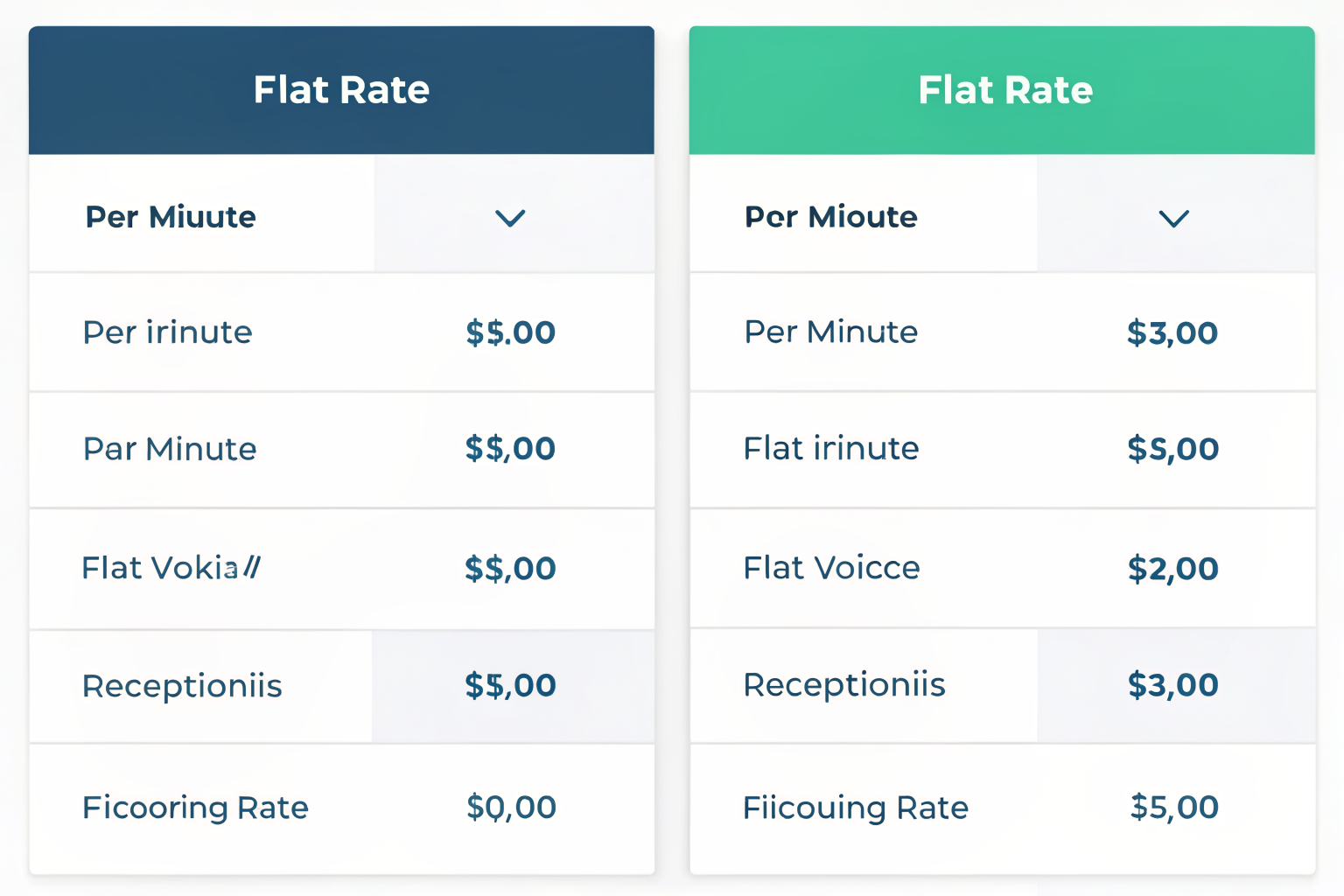
Pricing model is a separate decision from tier. You can buy a Tier 2 AI voice receptionist on per-minute billing or flat-rate billing, and that choice changes your monthly bill more than almost anything else. Per-minute pricing becomes more expensive than flat-rate at approximately 300+ minutes of handled call time per month. For most real small businesses, flat-rate wins.
Here’s how each model works.
Per-minute billing charges you for each minute the AI handles a call, typically $0.10–$0.35/minute depending on the vendor and plan tier. Some vendors bill per handled minute; others bill per billable interaction, rounding up to the nearest minute or in 30-second increments. The base plan fee is lower, which is what attracts buyers. The variable component is what gets them.
Flat-rate billing charges a fixed monthly fee for unlimited call handling up to a defined cap (or genuinely unlimited, depending on the vendor). Your bill is predictable. Call volume spikes don’t create invoice surprises.
The breakeven math is not complicated. At $0.25/minute, 300 minutes of monthly call time costs $75 in usage alone, before the base platform fee. If the base fee is $49, your total bill hits $124. A flat-rate plan at $97–$197/month covers the same call volume with no overage risk. At $0.10/minute, the crossover shifts higher, around 500–600 minutes, but it still exists.
| Criteria | Per-Minute Pricing | Flat-Rate Pricing |
|---|---|---|
| Monthly predictability | Low, bill varies with call volume | High, fixed cost regardless of volume |
| Low-volume cost (under 50 calls/month) | Can be cheaper; base fee is lower | May pay for capacity you don’t use |
| High-volume cost (300+ minutes/month) | Punishes you; overages compound | Fixed cost absorbs the volume |
| Phoenix seasonal risk (monsoon/summer HVAC spikes) | High, June–September call surges create penalty billing | None, flat rate absorbs the surge |
The seasonal dynamic matters a lot in the Phoenix market. HVAC companies get hammered with emergency calls from June through September. Pool service companies handle surge volume from spring startup through monsoon season. A per-minute plan that looks reasonable in February looks very different in July. That’s not a hypothetical; it’s a pattern any Phoenix contractor will recognize.
Per-minute pricing suits one type of business well: a very low-volume operation taking fewer than 50 calls a month, where the base fee on a flat-rate plan represents wasted capacity. A two-chair salon with existing walk-in traffic and minimal inbound calls might genuinely be better served by per-minute. Everyone else should run the math on their actual call volume before signing a per-minute contract.
The reasons callers hang up when they don’t get an immediate answer and how that connects to per-minute overage risk is a thread worth following. Understanding why callers hang up small business contexts at such high rates, 67% hang up without immediate assistance, changes how you think about plan design entirely.
AI vs. Hybrid vs. Live: Three Tiers, Three Different Cost Structures
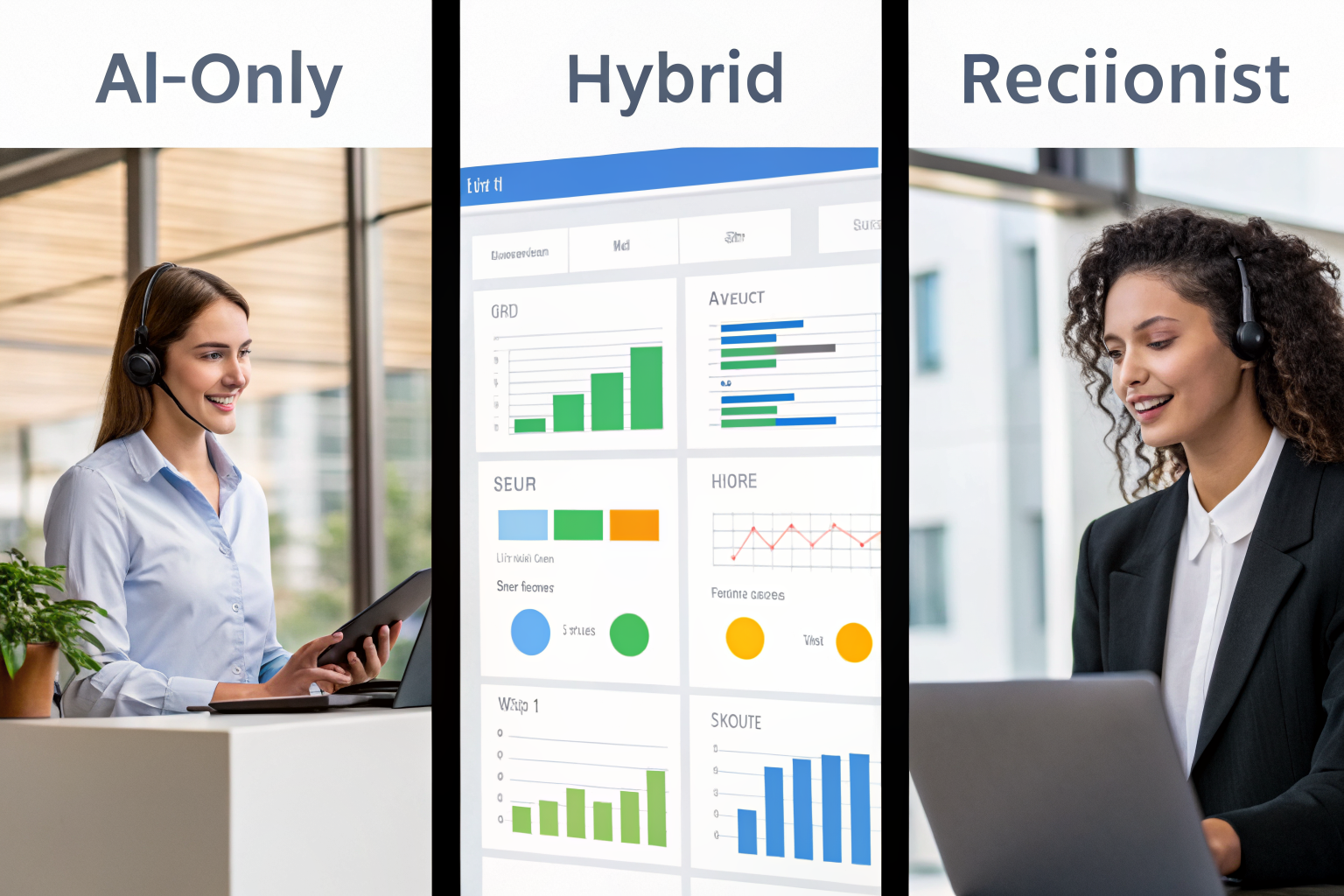
The price-band section above mapped what the market charges. This section explains why each tier costs what it does, which tells you whether the price premium at each level is worth paying for your specific situation.
AI-only receptionists cost 60–80% less per month than hybrid or fully live answering services. The reason is structural. Software runs 24/7 with no human labor cost in the loop. There is no shift schedule, no overtime, no sick day, no benefits negotiation. The AI handles qualification, FAQ deflection, and appointment booking without a person involved at any point. That’s the cost advantage. It’s not a feature of how clever the AI is; it’s a function of replacing hourly human labor with software.
The limitation is real and worth stating directly: edge cases and high-emotion callers hit a ceiling with pure AI. A caller who is confused, upset, or dealing with a complex situation that doesn’t fit the script will feel the friction. Some will hang up. This is the objection that gets raised most often about AI receptionists, and it’s legitimate in certain contexts.
Hybrid tier adds live human escalation on top of the AI core. The AI handles 80–90% of calls. A live agent picks up when the caller asks for a human, when the call falls outside the script’s range, or when the AI detects high-emotion signals. That human availability costs money. The typical premium over AI-only runs 2–4x, which is why hybrid plans cluster in the $299–$899/month range. You’re paying for labor-on-standby.
Live answering services with an AI bolt-on flip the model. Human agents are the primary handler; AI assists with triage, note-taking, or routing. Human labor is the cost driver here, and it sets the floor at $500–$1,200+/month. The AI layer improves efficiency at the margins but doesn’t change the fundamental economics. These are legacy answering service businesses that have added AI marketing language without changing their cost structure.
| Service Type | Typical Monthly Cost | Who Handles Calls | Escalation Path | Best-Fit Business |
|---|---|---|---|---|
| AI-only | $97–$497/month | AI handles all calls 24/7 | No live escalation; call logging and callbacks | High-volume trades, appointment-based businesses, after-hours coverage |
| Hybrid AI + Live | $299–$899/month | AI handles routine; live agent takes escalations | Real-time handoff to live agent | Law firms, medical intake, high-stakes or complex calls |
| Live answering + AI bolt-on | $500–$1,200+/month | Human agents primary; AI assists | Human judgment on every call | Businesses where every call requires a person by policy |
The comparison between ai vs human receptionist approaches gets covered in depth in a dedicated article, but the cost structure here tells most of the story: you are paying for human availability in tiers 3 and 4, and that human availability has a market price that doesn’t compress the way software costs do.
Choosing hybrid is not a failure of confidence in AI. For a personal injury law firm doing intake on potential clients, or a med-spa scheduling consultations that require pre-screening, hybrid is the right call. The question is whether your actual call mix justifies paying 2–4x more for the escalation layer. Most HVAC companies, pool services, salons, and general contractors do not have that call mix. A plumber getting a call about a backed-up drain at 8pm does not need a live escalation path. He needs the job booked.
What Are the Hidden Costs of an AI Receptionist?
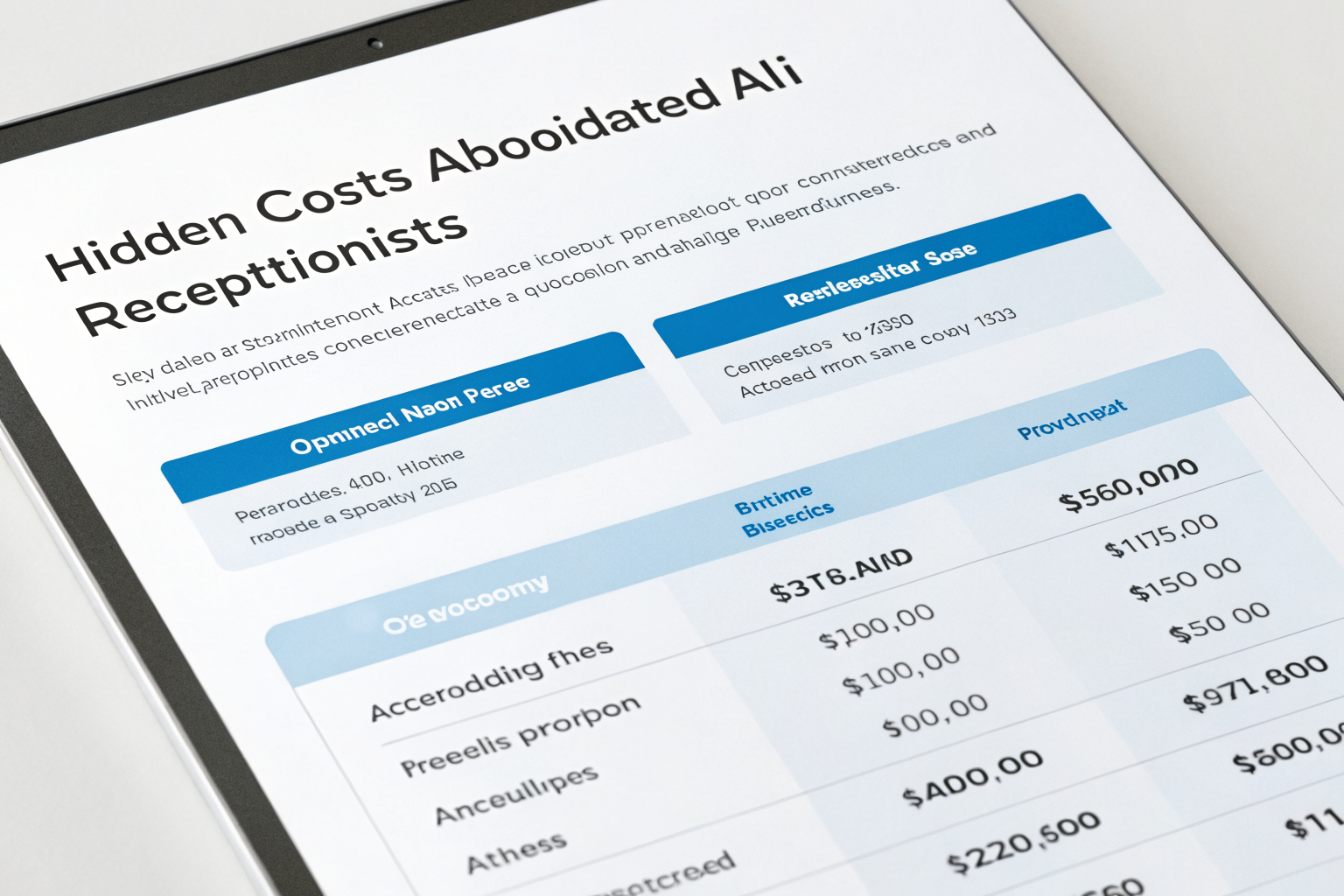
Hidden costs increase total AI receptionist spend beyond the advertised monthly rate. The monthly fee is the number that shows up in the headline; the items below are the ones that show up in the invoice. Know them before you sign.
- Setup and onboarding fees: Some vendors charge $99–$500 one-time to build your call script, map your qualification flow, and integrate your calendar. Others include setup in the monthly fee. This is the first question to ask before comparing monthly rates side by side.
- Overage fees on per-minute plans: If your plan includes 200 minutes and you go over, additional minutes often bill at penalty rates running 1.5–2x the base per-minute rate. A busy week during peak season can turn a $99/month plan into a $200+ bill.
- CRM and calendar integration costs: Standard integrations with popular tools like Google Calendar or common booking platforms are usually included. Deep integrations with industry-specific software (field service management, EHR-adjacent scheduling tools) may carry additional fees, either one-time or monthly.
- Script customization beyond the standard template: A basic qualification script is typically included. Multi-path logic, industry-specific branching, or custom objection handling beyond the standard template may carry a setup fee or require a higher plan tier.
- Contract lock-in and cancellation terms: Month-to-month pricing is the baseline to compare against. Annual contracts often look cheaper per month by 10–20%, but early termination fees can run one to three months of the remaining contract value. Read this before you sign.
- Number porting fees: If you want your existing business phone number to ring through the AI system rather than using a new number, some vendors charge a one-time porting fee of $25–$75, and the porting process takes 1–2 weeks.
Vendors who bury overage rates, porting fees, or integration costs in the fine print are worth walking away from. The no-risk baseline is simple: month-to-month contract, no setup fee, flat-rate call handling. If a vendor asks you to deviate from that baseline, make sure you understand exactly what you’re trading and why.
Live answering service pricing models have a longer history of layering in hidden charges than AI-native platforms, largely because the industry evolved before pricing transparency was a competitive differentiator. The detailed breakdown of live answering service pricing models is worth reviewing before any side-by-side comparison.
AI Receptionist Cost vs. Hiring a Receptionist in Phoenix: The Salary Math
Phoenix receptionist salary reaches $30,000–$42,000 per year in base wages, making AI answering services cost roughly 85–90% less annually. That gap is the number most business owners haven’t run before they start shopping for a phone solution.
BLS and current market data for the Phoenix metro put front-desk and receptionist roles at $30,000–$42,000/year in base salary for 2026. That’s the number on the offer letter. The number on your P&L is different. Add employer payroll taxes (roughly 7.65% in FICA alone), health insurance contributions, paid time off, and the cost of training a replacement when the person leaves (and receptionists turn over), and the fully loaded cost of a human receptionist runs approximately 1.25–1.4x base salary. That puts the real annual cost between $37,500 and $58,800.
For that $37,500–$58,800, you get coverage for roughly 40 hours per week. Calls before 8am, after 5pm, on weekends, and during your busiest work hours when the receptionist is already on another call: those go to voicemail. The 40-hour figure is not a knock on the employee. It’s the structural reality of human availability.
An AI answering service at $397/month runs approximately $4,764/year. It answers calls 24 hours a day, 7 days a week, 168 hours per week. The coverage comparison isn’t close.
The missed-call revenue context matters here. 85% of missed calls never call back. A single missed HVAC service call during a Phoenix summer is worth $400–$600 in booked revenue, before any follow-on work. One recovered job pays for several months of an AI plan. A missed $3,000 roofing job pays for the plan’s entire year, with money left over. That’s not an edge case; it’s the ordinary math of any trade business running calls through voicemail after hours.
The salary thread runs through every cost-related article in this cluster because it is the comparison that resets the conversation. Buyers who frame AI receptionist cost as a technology purchase get stuck on the monthly fee. Buyers who frame it as a staffing decision compare it against what a human alternative actually costs, and the math resolves quickly.
Sledgehammer Intelligence plans start at $397/month with a 14-day trial. That puts the annual spend at $4,764, against a Phoenix receptionist’s fully loaded cost of $37,500–$58,800. The gap is $32,000–$54,000 per year, and the AI covers more hours.
This section covers the cost comparison only. The full ROI calculation, including payback period and per-vertical revenue recovery figures, lives in the Phoenix AI automation ROI article.
What’s the Cheapest AI Receptionist, and Is It Actually Worth It?
The cheapest AI receptionist tiers lack voice qualification and calendar booking, which are the two features that recover missed-call revenue. This is the thing most guides on this topic skip, because they’re either written by vendors selling those cheap tiers or by writers who haven’t run the numbers.
The cheapest products in the market, the $25–$50/month tools, run text-back only. They do not pick up the phone. When a caller hits your voicemail and gives up, the tool sends a text two minutes later: “Sorry we missed you, can we help?” Some callers respond. The ones who were patient enough to stay engaged with your business after hitting voicemail will re-engage with a text prompt. But the problem is not the callers who are patient. The problem is the 85% who never call back.
A caller who got a ring-out with no answer and then received a text two minutes later may or may not respond. A caller who got a ring-out, heard a competent AI voice answer on the third ring, got their question answered, and booked an appointment before they even considered calling the next result on Google: that caller is converted. Those are two different products solving two different problems at two different price points.
Middle-market AI voice plans in the $97–$297/month range answer live calls, run a qualification script, and drop appointments into your calendar. Script depth and integration options vary by vendor at this price point. Some national SaaS platforms offer credible voice-plus-booking functionality starting at $97–$197/month, but typically without local service support, custom setup, or anyone to call when the script needs adjusting.
The floor for a real AI voice receptionist that books jobs sits at approximately $97–$197/month from national platforms. Below that, you are buying a text-back tool and calling it an AI receptionist.
But the right frame isn’t “cheapest.” It’s what a single recovered job is worth to your business. An HVAC service call in Phoenix averages $400–$600. A salon booking is $80–$200. A roofing estimate call could be a $10,000 job. If your AI plan costs $200/month and recovers two jobs it would have lost to voicemail, it paid for itself in the first week. The monthly fee is not the variable that matters. Call recovery rate is the variable that matters, and cheap text-back tools don’t move that number for callers who hung up.
Before you compare price tags, call (888) 789-8030 and hear what a voice-capable AI receptionist sounds like when it picks up. That call takes 90 seconds and tells you more than any pricing page will.
Frequently Asked Questions
How much does an AI receptionist cost per month for a small business?
AI receptionist plans for small businesses range from $25/month for basic text-back tools to $899/month for hybrid AI-plus-human services. The core market for a full AI voice receptionist that answers calls, qualifies leads, and books appointments runs $97–$497/month. Sledgehammer Intelligence plans start at $397/month with a 14-day trial.
Is an AI receptionist cheaper than hiring a real receptionist?
Yes, and the gap is large. A Phoenix receptionist costs $30,000–$42,000 per year in base salary, and benefits, payroll taxes, and turnover push the fully loaded cost to $37,500–$58,800 per year. An AI answering service at $397/month runs approximately $4,764 per year and covers calls 24 hours a day, seven days a week, not just during business hours.
What is the cheapest AI receptionist that actually answers calls?
Credible AI voice receptionists that answer live calls, qualify callers, and book appointments start at roughly $97–$197/month from national SaaS platforms. Sub-$100 products are text-back tools. They do not pick up the phone. If your business loses jobs to missed calls, a voice-capable plan is the minimum that changes the outcome.