
AI receptionist for salons solves the problem every chair-full Saturday creates: the phone rings, every stylist is mid-blowout, and the caller books the next salon on Google instead. This article covers how salon-specific AI call handling works, which booking platforms it connects to, and whether it fits your front desk, whether you run one chair or twenty.
Key Takeaways:
- 85% of missed calls never call back, for a salon running 8-10 chairs, that is a direct, recurring revenue leak every week.
- Lunch-hour and Saturday morning call surges are the two highest-volume windows for salon booking calls, and both hit exactly when every chair is full and no one is free to answer.
- An AI receptionist for salons integrates with scheduling platforms like Vagaro, Fresha, and Boulevard to book appointments directly into the live calendar, no double-entry, no callback required.
What Does a Receptionist for a Salon Actually Need to Do?

A receptionist for a salon is a caller-qualification and booking engine, not just a phone-answerer. This means the role requires checking live calendar availability, identifying the service type, confirming stylist preference, and holding the slot before the call ends. For example, when a new client calls asking for a balayage on a Saturday morning, the receptionist needs to know which stylists do color, which slots are open, and whether a deposit is required before confirming anything.
That is a fundamentally different job than answering a general business inquiry. It requires real-time calendar access and caller qualification before a booking is confirmed. A stylist cannot step away mid-service to do any of that. She is holding a foil brush with gloved hands and has a client in her chair for the next ninety minutes.
This is the core front-desk problem salons face that most other business types do not. A law firm’s caller can leave a message. A restaurant caller can check the website for hours. A salon caller is trying to book a specific service with a specific person in a specific time window, and if that transaction does not complete on the first call, it usually does not complete at all.
92% of customer interactions happen over the phone. For salons, the majority of those are booking calls that arrive during peak service hours when every staff member is occupied. The AI receptionist fills that role with the same qualification logic a human would use: service type, stylist preference, availability window, confirmation, and a text to lock it in. What it does not do is put the caller on hold while it checks with someone, or ask them to call back later.
If you have read about AI for customer service in small business broadly, the salon use case is where the 24/7 answering argument gets sharpest. The hours between 10am and 2pm on weekdays, and the entire Saturday morning window, are simultaneously the highest-demand booking windows and the lowest-capacity answering windows for any multi-chair floor.
Booking While Stylists Work: How the AI Handles Calls Mid-Service
The AI receptionist captures and books salon appointments in real time without interrupting active service staff. Here is the exact sequence a caller moves through:
- Call comes in. The AI answers within the first ring, greets the caller with the salon’s name and a natural opening line scripted to the salon’s brand voice.
- Service type collected. The AI asks what service the caller is looking for, haircut, color, blowout, extension consultation, and records the response.
- Stylist preference confirmed. The caller is asked whether they have a preferred stylist or are open to the next available person. If a specific stylist is requested, the AI checks that stylist’s calendar directly.
- Live availability pulled. The AI reads the connected scheduling platform in real time and identifies the next two or three open slots that match the service length and stylist.
- Slot offered and selected. The caller picks from the offered options. The AI does not offer slots that conflict with existing bookings.
- Booking written. The AI writes the appointment into the live calendar, creates or updates the client record, and closes the slot so no double-booking can occur.
- Confirmation sent. The caller receives a text confirmation with the appointment details before the call ends.
67% of customers hang up if they do not receive immediate assistance. For a salon, a hold or voicemail at peak hours produces the same outcome as no answer at all, the caller is gone.
The Saturday morning scenario is the clearest proof of need. At 9:30am on a Saturday, a salon with eight chairs has eight stylists in active service, the front desk person is checking in walk-ins, and the phone is ringing. Without the AI, that call goes to voicemail. With it, the caller completes the booking in under three minutes while every stylist stays focused on the client in front of them.
This is also where the lunch-rush window operates the same way. From 11am to 1pm on weekdays, incoming booking calls and peak chair occupancy overlap. The AI handles 100% of inbound calls in that window. Callers do not experience a difference in response quality.
If you want to hear what this sounds like before making any decision, call (888) 789-8030 right now. That is the same conversation your callers would have.
Salon Software Integration: Does the AI Actually Connect to Your Booking System?
The top practical objection from salon owners evaluating an AI receptionist is not cost or sound quality. It is this: “I already use Vagaro. Will the AI actually connect to it, or will I be managing two calendars?”
The salon AI receptionist integrates with scheduling platforms including Vagaro, Fresha, and Boulevard to read and write live availability. That means it checks what is open, books into it, and syncs the client record, without requiring a human to confirm or re-enter the appointment afterward.
Vagaro, Fresha, and Boulevard collectively serve the majority of independent salon and spa operators in the US. Integration with at least one of these is the baseline expectation any serious operator will bring to an evaluation.
The table below covers the major platforms and what the integration does or does not include. Integration status should be verified at contract time, as platform APIs change.
| Scheduling Platform | Read Live Availability | Write New Bookings | Sync Client Records | Notes |
|---|---|---|---|---|
| Vagaro | Yes | Yes | Yes | Full two-way sync; most common integration request |
| Fresha | Yes | Yes | Yes | Full two-way sync; strong independent salon adoption |
| Boulevard | Yes | Yes | Yes | Full two-way sync; popular in Scottsdale/upscale spa segment |
| Mindbody | Yes | Varies by plan | Varies by plan | API access varies by plan tier |
| GlossGenius | Yes | Varies by plan | Varies by plan | Newer API; confirm current write access |
| Square Appointments | Yes | Yes | Partial | Client record sync limited; verify scope |
The distinction that matters most is full two-way sync versus notification-only handoff. Notification-only means the AI takes the caller’s information and sends a staff member a message to call back and confirm. That is not a booking, that is a lead. Full two-way sync means the appointment is in the calendar before the caller hangs up. The difference in conversion rate between those two outcomes is significant.
For the vast majority of salon owners, the question is not whether integration exists, it is whether the specific plan they are evaluating includes the write-access tier or only read access. Ask that question before signing anything.
Will an AI Receptionist Make Your Salon Look Cheap?
This is the objection most salon and spa owners raise before cost, before setup, before any other question. Pattern from owner-operator forums: the brand-image concern is the most-cited objection from salon and spa owners specifically, because the first customer impression is the product.
That signal deserves a direct response, not a dismissal.
The brand-image objection is real. A Scottsdale med-spa owner who charges $350 for a facial has built a premium positioning that starts at the first touchpoint. A Gilbert hair salon owner who has her regulars by name does not want her clients to feel like they called a phone tree. These are legitimate business concerns, not technophobia.
Here is what the AI actually does and does not do in that context. The AI is scripted to the salon’s exact name, voice, and service language before it goes live. A caller to “Salon Elara” hears “Thank you for calling Salon Elara”, not a generic greeting. The script reflects the salon’s tone, whether that is warm and conversational or polished and minimal. Callers hear the salon, not a vendor.
The comparison the brand-image objection usually ignores is what the alternative sounds like. A voicemail greeting recorded three years ago, a hold music loop, or a ring-out with no answer is the actual competitor. A professional, immediate response that books the appointment in under three minutes is not a downgrade from that experience. It is an upgrade.
Human handoff exists for calls the AI should not handle alone. Complex consultations, client complaints, pricing negotiations, and sensitive conversations get routed to a staff member. The AI qualifies and routes; it does not attempt to manage every call type end-to-end.
The honest caveat: callers will sometimes recognize they are talking to an AI. That is not a crisis. The relevant question is whether the experience was smooth and the appointment was booked. If both are true, the brand perception outcome is positive regardless of whether the caller identified the technology.
Call (888) 789-8030 and decide for yourself whether it sounds right for your clients. That is the only evaluation that matters.
No-Shows, Lunch Rush, and Weekend Overflow: The Three Gaps an AI Fills
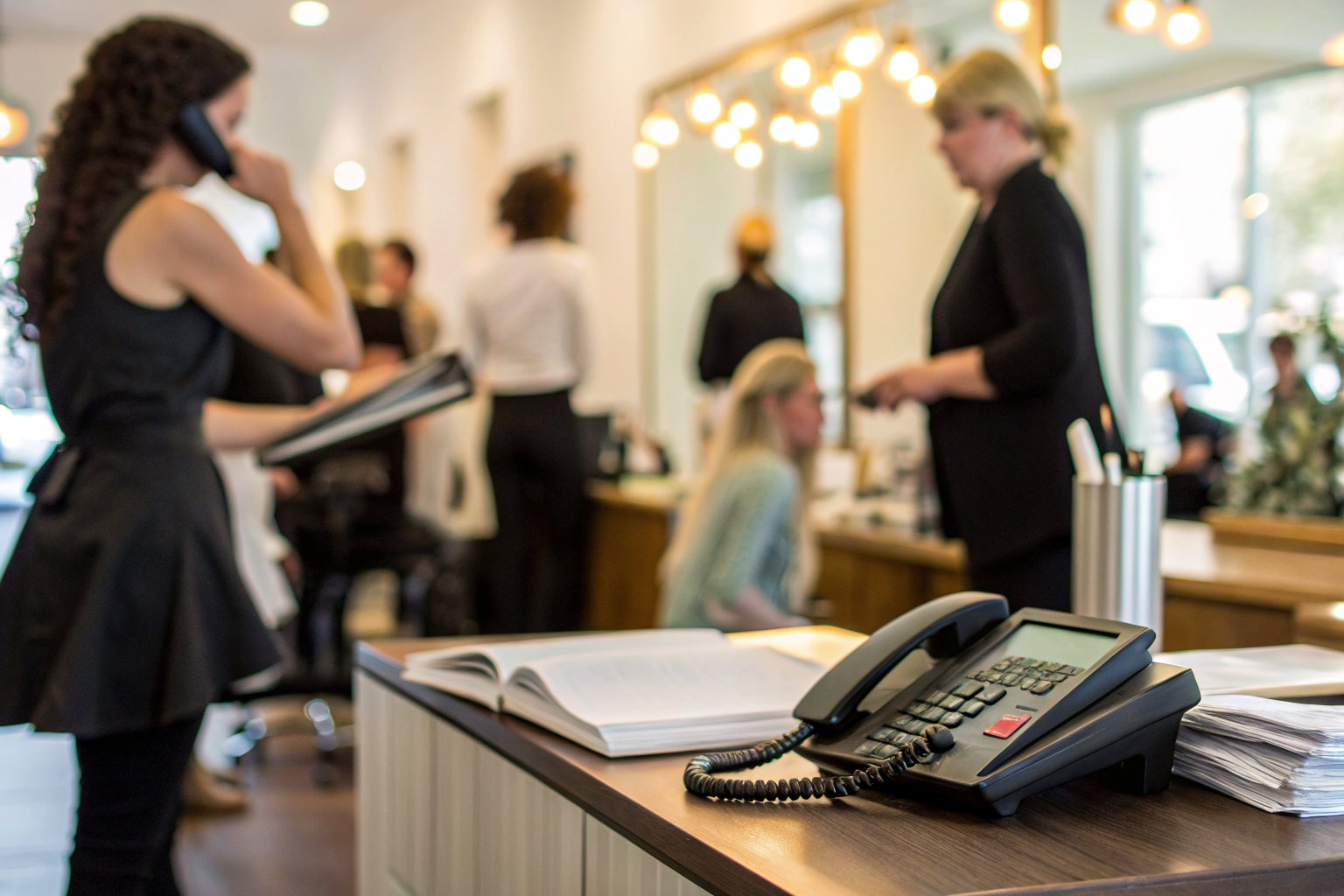
The salon AI receptionist reduces revenue loss from no-shows, midday call overflow, and weekend booking surges. These are three discrete, named problems with different mechanics, and the AI addresses each one differently.
85% of missed calls never call back. The no-show and overflow gaps are not isolated inconveniences; they are the same lost-revenue pattern repeating every single week.
- No-shows: A verbal booking made over the phone with no follow-up confirmation produces a different behavioral outcome than a booking with a text confirmation sent the same day. The AI sends an automated text confirmation immediately after the appointment is booked, and can send a reminder text in the 24-48 hour window before the appointment. A client who received a text with their stylist’s name, the service, and the time is less likely to forget than one who made a mental note during a busy morning.
- Lunch rush (11am-1pm weekdays): This is the window where peak chair occupancy and peak incoming call volume overlap. Every stylist is mid-service, the front desk is managing the floor, and the phone is ringing. A caller who hits voicemail at 12:15pm on a Tuesday does not call back at 4pm when someone is free. The AI handles every inbound call in this window without the caller experiencing a wait, a hold, or a transfer.
- Saturday morning overflow: Saturday 9am-noon is the highest single booking-demand window of the week for most salons. It is also the morning most likely to have a staffing gap, a receptionist who called out, arrived late, or got pulled to cover another task. The AI is unaffected by staffing variance. It answers the same way on a Saturday morning with two staff absent as it does on a fully-staffed Tuesday.
- After-hours inquiries: Callers who search for a salon at 8pm on a Sunday are a distinct booking opportunity that a human receptionist structurally cannot capture. The AI handles these calls, books into the next available slot, and sends the confirmation. The stylist arrives Monday morning with appointments already on the calendar.
For salon owners who want to see how the no-show and overflow gaps interact with cost math, that analysis lives in the ROI and cost-guide content. This section covers the mechanics; the numbers behind each gap are covered separately.
The through-line across all three gaps is the same: the AI does not need a break, does not call out on Saturday, and does not send callers to voicemail because both hands are busy. Other appointment-based business types face versions of this problem too. An answering service for medical offices faces the same midday overflow pattern. An AI receptionist for dentists handles the same new-patient qualification problem. An AI receptionist for restaurants deals with the same peak-hour booking surge. What makes the salon case specific is the stylist-client relationship layer, the caller often wants a particular person, not just any available slot, which is why the qualification step in the call flow matters more here than in most other front-desk verticals.
For field-service businesses like pool service and HVAC, the problem flips: the owner is out of the office entirely rather than occupied in it. An AI receptionist for pool service and an AI receptionist for HVAC both solve the same missed-call problem from a different physical context. Salons and law firms share the front-desk structure, an AI receptionist for law firms runs the same intake qualification logic the salon AI uses, adapted for legal intake rather than service type. The common thread across every vertical is front-desk operations that cannot scale by adding headcount every time call volume increases.
Frequently Asked Questions
Can an AI receptionist handle new client intake for a hair salon?
Yes. The AI qualifies new callers by asking for service type, preferred stylist, and availability window, the same questions a human receptionist would ask. It then checks the live calendar, offers open slots, and confirms the booking directly. New client records are created in the connected scheduling platform without requiring a staff callback.
What’s the difference between an AI receptionist and just using online booking for my salon?
Online booking requires the client to find your booking page and navigate it on their own. Many callers, especially older clients or people searching on the go, will call instead of self-booking. An AI receptionist captures those phone callers in real time and books them into the same calendar your online booking uses. It handles the clients who will not book themselves.
Does a salon AI receptionist work for a solo stylist or only multi-chair salons?
A solo stylist faces the missed-call problem at higher intensity because there is no staff to answer when they are in a service. The AI handles every inbound call, books into the stylist’s calendar, and sends the client a confirmation, whether the business has one chair or twenty. The ROI is arguably higher for solos because every missed call is a direct personal revenue loss with no team to absorb it.